Sonder
“The awareness that other people all have their own complex set of feelings and experiences.”
(Merriam-Webster Dictionary)
Idea
Practice
- Artist Statement
Who we are is constantly changing. We are made up of memories and experiences which leave impressions on us mentally, emotionally, and physically… and as these things change us the differences between our current and our past selves become greater and greater. However, the people we have been still linger on in this world as echoes in the memories of others: a former teacher remembers the person you were two years ago; a childhood friend knows the version of you that existed 5 years ago; your parents’ memories hold overlapping copies of you, previous iterations only partially overwritten by subsequent variations, with none of them matching the ‘you’ that exists now. Dead copies of our former selves speak from the grave in old school essays, archived chat logs, previous postings on social media, text messages and emails.
Sonder is an attempt to use art and technology to provoke thought, to make people reflect on what lessons we can learn from past versions of ourselves and others. In what ways is our “current” self better than previous versions? In what ways are we not as good? What have we gained, and what have we lost along the way? And how can this awareness improve our interactions with other people, knowing that the person we meet (or know, or love) will likely not be the same person we remember? Visitors are also invited to write down and share their thoughts, making the installations collaborative, unique and random.
- Summary
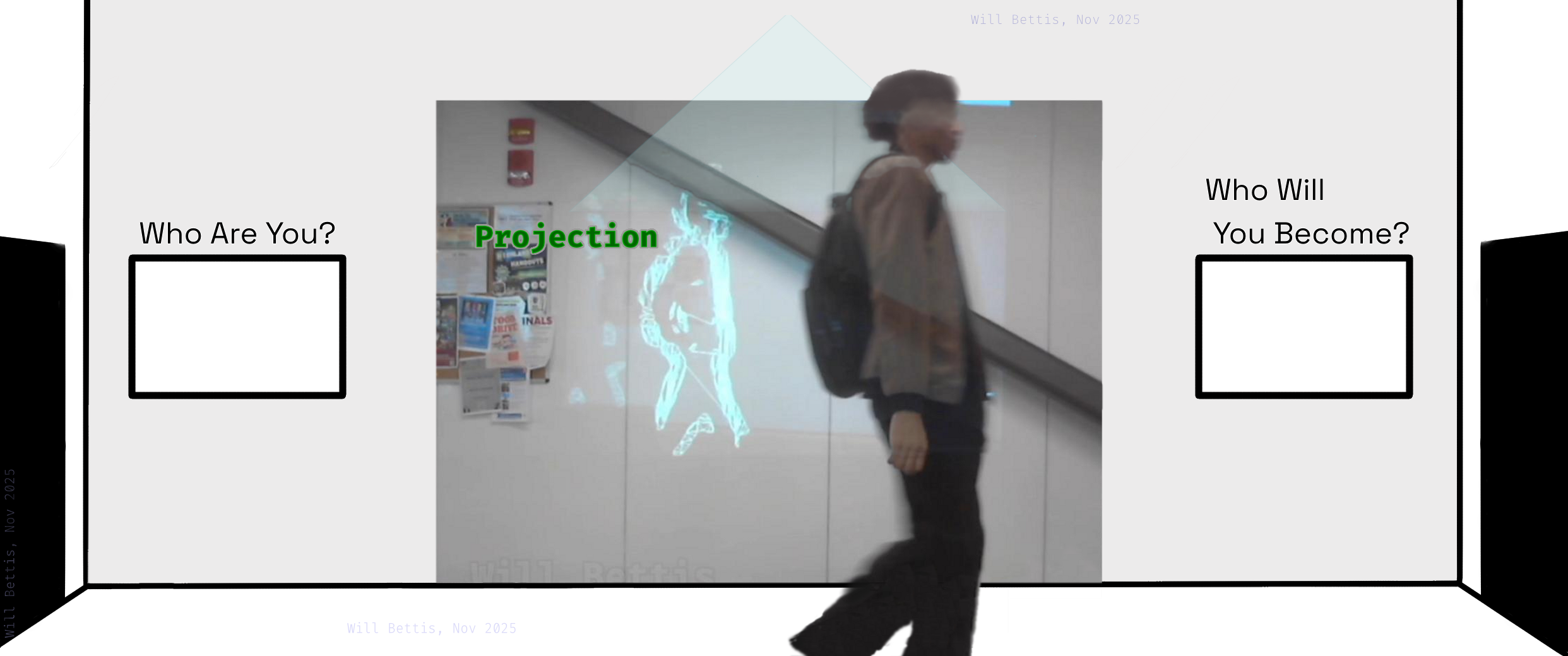
To reflect our own transitional nature this installation is intended to occupy transitional spaces such as hallways, concourses, or walkways, as well as other connective spaces such as foyers, lobbies, or porticos. Any place where people would already pass through anyway and which has a nearby blank wall would be suitable: this installation focuses more on the concept and it is expected that the form will vary slightly to accommodate different locations. Possible locations in Tucson include public spaces near and around government buildings downtown, libraries, spaces at the University of Arizona or Pima Community College, or the airport.
For the installation a camera captures video of people as they pass through the chosen space, and that video is projected onto a wall (with a few seconds of delay). Ghostly outlines follow each person as they move through the space, representing how we are constantly creating (and being followed by) echoes of ourselves. At regular intervals the projected image will fade to a version of the artistic statement, and then back again.
Two sheets of white-painted MDF (or dry-erase surfaces) are installed with one at either end of the space, with markers and/or pens nearby. “Who Have You Been?” appears in large letters at the top of one, “Who Will You Become?” is written at the top of the other. (Variations of this are possible, and could change periodically: “I Wish I Had…” / “I Hope That I Will Be…”, “If I Could Say Goodbye…” / “If I Could Do Anything…”, “Letting go of…” / “Holding On To…”, etc.) The installation would be updated regularly, with written contributions from visitors put into the program to randomly be displayed in the projection.
The installation components consist of at least one camera, at least one projector, a micro-computer such as the Raspberry Pi to run the software, and a laptop to program and interface with the Raspberry Pi. Touchdesigner software is used to process video input in real time and produce output for projection. The installation can be scaled up to include multiple camera / projector pairs which could (for example) allow one person to navigate relatively seamlessly through several connected spaces, trailed by their ghostly doppelgangers the entire time. Placement of the projectors can be highly flexible: Touchdesigner is regularly used for projection mapping, so odd angles or minor surface variations should be relatively straightforward to compensate for.